I study the interstellar medium (ISM) on small scales. My graduate school research primarily focuses on "CO-Dark" molecular hydrogen (H2), in particular discovering new ways to accurately measure how much H2 is not traced by CO emission.
I study the formation of giant molecular clouds (GMCs). Giant molecular clouds are clouds of dust and gas in space, they are the birthplaces of stars and an integral part of a galaxy's lifecycle. GMCs are mainly comprised of molecular hydrogen (H2), the most abundant molecule in the universe. This complicates studying GMCs because H2 does not emit light in normal circumstances due to its lack of dipole moment. Tracing the H2 gas is important for understanding the its formation and therefore the formation of GMCs themselves. One of the primary ways of calculating H2 mass is via a conversion from 12CO(J=1-0) to MH2, called the XCO-factor. This does not trace all of the H2 and can miss up 50% of the H2 gas. This H2 gas without corresponding CO emission is called "CO-Dark" gas. Some of my research focuses on tracing this "CO-Dark" gas using other ways.
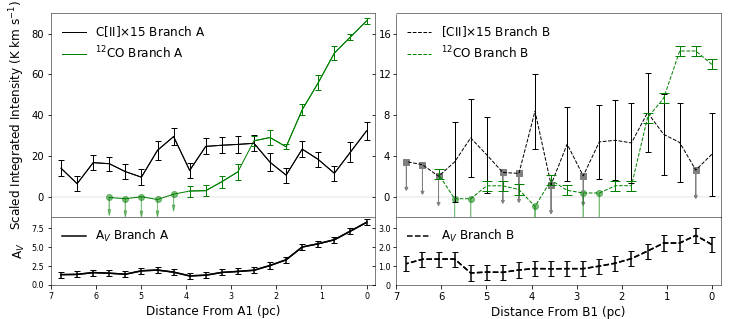
My most recent publication, "Herschel 158μm [CII] Observations of "CO-Dark" Gas in the Perseus Giant Molecular Cloud", focuses on tracing "CO-Dark" using [CII] 158μm emission. It is available either via the Astrophysical Data System: ADS page or more directly, the ArXiv: ArXiV pdf. I find that the [CII] emission remains flat across the boundary region of Perseus, spanning an AV range of 8.5-1mag. This flat trend of [CII] emission indicates that in certain density and temperature regimes, like those found in Perseus, [CII] emission cannot be used to distinguish between diffuse H2 and the HI envelope. Here are the integrated intensity profiles for two different boundary regions within Perseus, Branch A on the left where "CO-Dark" gas is found, and branch B where the CO emission and the derived H2 agree. This is integrated intensity of [CII] in black and 12CO in green as a function of distance from first position. The bottom panel of both are AV as a function of distance.
My current project focuses on the simple molecules OH and CH as tracers for diffuse H2. The idea in its essence is that OH and CH are both steps on the way to CO formation and get photodissociated without enough dust shielding; values of AV≲1. In order to analyze the spatial relationship between CO and OH and CH, we requested time on both the Arecibo and GBT telescopes, while using archival CO surveys of the Perseus giant molecular cloud. As I am wrapping up this project I am starting a project to measure thermal pressure for five positions within the Perseus GMC.
I am Co-I on a project to directly measure thermal pressure for five positions encompassing three different environments within a single GMC for the first time, as opposed to sightlines scattered across several GMCs. HI and H2 gas volume densities and temperature can be calculated from the combination of HI absorption and [CII] emission observations, allowing for accurate and fairly precise measures of thermal pressure (Goldsmith et al. 2018). Thermal pressure, P/k, is key to understanding the multi-phase medium which surrounds GMCs. Recent numerical simulations by Dobbs et al. (2012) suggest that GMCs typically form out of thermally unstable atomic hydrogen with a density of a few cm3. Our observations will be able to directly test this prediction.
Finally, I am part of two other collaborations: XLARGE (PI: Dr. Adam Leroy) and ESPOIR (PI: Dr. Min-Young Lee). XLARGE is a large VLA project to observe HI 21cm emission from six nearby galaxies in unprecedented resolution from 8-20pc. My part in this collaboration it to statistically understand the HI-H2 transition for over 1000 clouds across a very wide range of environments. The second collaboration, ESPOIR, is a survey of HI-absorption sources within the Perseus GMC. This survey will be the first to have such a high density of sources, increases the number density of source by a factor of 20 within Perseus.
Dobbs et al. 2012
Goldsmith, P. F. 2018